
Follow our journey through past race reports, lessons learned, and the road to upcoming HYROX events.
SIMULATION RACE ESPOO / FINLAND 7.3.2026
HYROX Simulation Race Espoo
The Start of the DrivenBySISU Journey
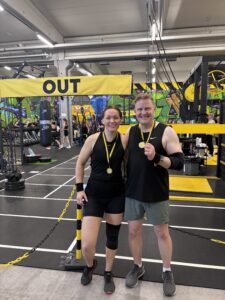
Event: HYROX Simulation Race
Location: Espoo, Finland
Organizer: OCR Factory
Team: Sami & Katja
Category: Mixed Doubles Simulation
Introduction
Every journey needs a starting point.
For us, the HYROX Simulation Race in Espoo was much more than a workout or a test event. It became the first real benchmark on our road toward becoming competitive HYROX athletes and building the DrivenBySISU project.
At the time, we knew we were motivated, disciplined, and willing to put in the work, but we didn’t yet know how our strengths and weaknesses would appear in a true HYROX environment.
Espoo gave us those answers.
Race Day
The atmosphere was energetic and supportive from the very beginning.
Our goal was not to chase a specific finish time. Instead, we wanted to learn as much as possible.
We wanted to understand:
- How our bodies respond to HYROX race intensity.
- How well we perform together as a team.
- Which stations are our strengths.
- Which areas require the most attention.
- How we handle fatigue when the race starts to hurt.
Looking back, that mindset allowed us to gain more from the event than any result alone could have provided.
What Went Well
Teamwork
One of the biggest positives of the day was discovering how naturally we work together during competition.
HYROX Doubles is not only about fitness. Communication, pacing, trust, and decision-making all matter.
The race confirmed that we complement each other well. When one of us was pushing hard, the other could recover and prepare for the next effort.
That partnership has remained one of the strengths of our training ever since.
Work Capacity
The simulation showed that we already had a solid fitness foundation.
Farmer Carry, SkiErg and Rowing felt relatively comfortable compared to some of the other race elements. Even as fatigue increased, we were able to keep moving and continue producing work.
That gave us confidence that the engine was already there.
Mental Resilience
Like every HYROX race, there were moments when the effort became uncomfortable.
Espoo reminded us that mental strength is just as important as physical fitness.
We learned that we could continue making good decisions and managing our effort even when fatigue started to build.
What We Learned
Expect the Unexpected
One of the most memorable lessons of the day happened before the race had even started.
The evening before, we carefully planned our race morning. At least that is what we thought.
Unfortunately, we got the schedule wrong.
While sitting on the metro on our way to the venue, we suddenly realized that there were only about 40 minutes left until the start, and it would still take us approximately 30 minutes to walk from the station to the race venue.
At that moment, there was no time to stress.
Instead, we made a quick decision.
Our planned warm-up was replaced by a fast-paced run from the metro station to the race venue while carrying our race gear and trying to arrive before the start. Looking back, it was not exactly the pre-race routine we had imagined.
The experience was a good reminder that races do not always begin when the clock starts. Sometimes they begin much earlier.
More importantly, it reminded us that things rarely go exactly according to plan. The ability to stay calm, adapt, and keep moving forward is often just as valuable as physical fitness.
In many ways, that unexpected run to the venue became the first true Sisu Moment of the day.
Running Between Stations
The biggest lesson from Espoo was clear.
Running needed improvement.
The race exposed one of the most important realities of HYROX:
Running while fatigued is completely different from running fresh.
Although we could run reasonably well on its own, maintaining pace after demanding stations proved much more challenging.
This became the primary focus of our training after the race.
Pacing Matters
HYROX rewards patience.
Espoo taught us that attacking every station with maximum intensity is not always the fastest strategy.
A slightly more controlled effort early in the race creates significant advantages later when fatigue accumulates.
This lesson continues to influence both our training and racing today.
Transition Efficiency
The event also highlighted how important efficiency is.
Small pauses become expensive.
Time is often lost in transitions, equipment changes, and unnecessary recovery moments.
Since Espoo, we have spent considerable time improving rhythm, flow, and movement efficiency throughout our simulations and training sessions.
How Espoo Changed Our Training
The simulation became the blueprint for the entire DrivenBySISU project.
Following the event, our training evolved around four key pillars:
Aerobic Development
Building a stronger running engine through structured Zone 2 training.
Threshold Running
Improving sustainable HYROX race pace.
HYROX Simulations
Practicing race-specific pacing, teamwork, and transitions.
Functional Strength
Building durability and strength that transfers directly into race performance.
Many of the workouts we still perform today can be traced back to lessons learned during this race.
Looking Back Today
Months later, the impact of Espoo is still visible.
Since that first simulation we have:
- Increased our running volume.
- Improved running economy.
- Built more consistent HYROX pacing.
- Completed numerous partner and solo simulations.
- Developed a deeper understanding of race strategy.
- Continued building the DrivenBySISU project and community.
Most importantly, we have learned that long-term progress is built through consistency rather than dramatic breakthroughs.
The Sisu Moment
The most memorable part of Espoo was not a particular station or split time.
It was the realization that we had started something bigger than a single race.
Standing together after crossing the finish line, tired but motivated, we knew this would not be our last HYROX event.
It was the beginning of a journey.
A journey built on discipline, consistency, partnership, and Finnish sisu.
Final Thoughts
Espoo was not perfect.
That is exactly why it was so valuable.
The simulation exposed weaknesses, revealed strengths, and gave us direction.
Every training session since then has been part of the response to what we learned that day.
Every race that follows, from Kuopio to Karlsruhe and beyond, has its roots in that first simulation.
The stopwatch measured our performance.
The experience shaped our future.
About the Event
The HYROX Simulation Race in Espoo was organized by OCR Factory and served as a valuable first benchmark in our HYROX journey.
Learn more:
https://ocrfactory.fi/fi-fi
DrivenBySISU
Built on consistency. Guided by purpose. Powered by Finnish Sisu. 🇫🇮🔥
SIMULATION RACE KUOPIO / FINLAND 8.8.2026
HYROX Simulation Race Kuopio
Proof of Progress
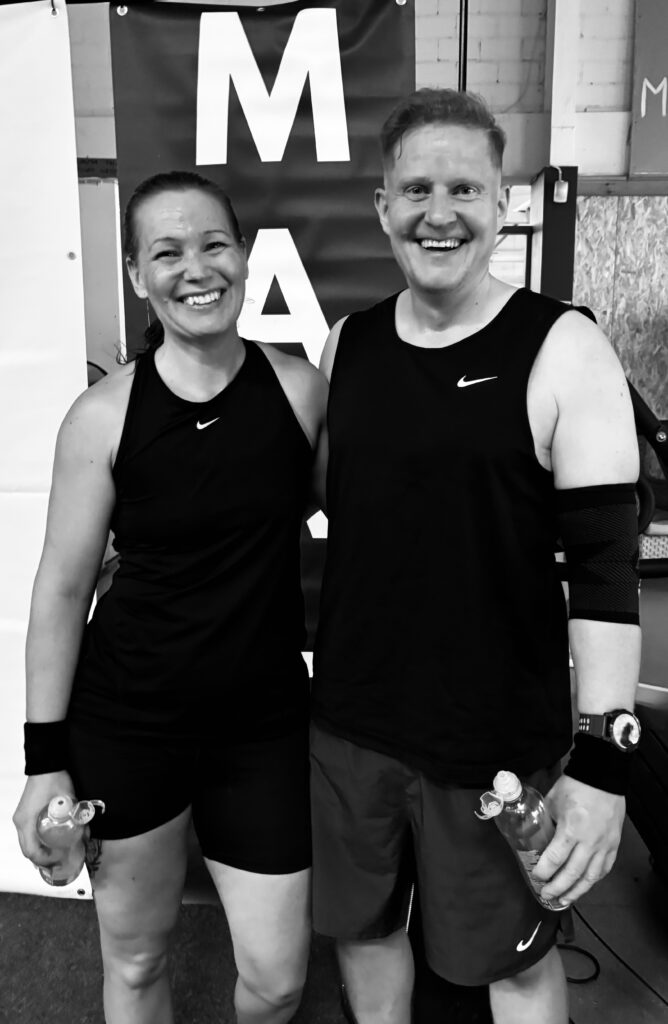
Event: HYROX Simulation Race
Location: Kuopio, Finland
Team: Sami & Katja
Category: Mixed Doubles Simulation
Part of: Road to Karlsruhe
Introduction
Five months earlier, the HYROX Simulation Race in Espoo gave us our first real benchmark.
Kuopio gave us something different.
It gave us proof that the work was paying off.
Since Espoo, we had invested countless hours into improving our running, building race-specific strength, completing simulations, and learning how to function more efficiently as a team. The goal was clear:
Become a faster and smarter HYROX doubles team.
Kuopio was our first opportunity to see how much progress had actually been made.
Different Course, Different Challenge
At first glance, the final result looked only slightly better than Espoo.
However, the courses were very different.
In Espoo, the running course was a smooth oval loop with a relatively short Roxzone.
In Kuopio, every kilometre consisted of four laps with repeated 180-degree turns where speed dropped almost to zero before accelerating again. The Roxzone was also significantly longer, adding roughly 100 metres of additional movement around each station.
The result was a course that demanded far more acceleration, deceleration, and race management than what we experienced in Espoo.
It felt much more like a true race.
Our Race Strategy
Unlike Espoo, we arrived in Kuopio with a clear plan.
The objective was simple:
Run consistent kilometres and keep moving.
Sami took responsibility for setting the running pace while Katja focused on maintaining rhythm and efficient station execution.
Throughout the simulation we committed to:
- Running all Roxzones
- Minimizing unnecessary stops
- Sharing work according to our strengths
- Staying disciplined with pacing
- Avoiding early-race heroics
The biggest success was that we followed the plan.
A short pause for hydration before each run was all we allowed ourselves before moving again.
Running Finally Felt Different
Perhaps the most encouraging takeaway from Kuopio was the running.
For months, running between stations had been our biggest challenge.
In Kuopio:
- The pace stayed remarkably consistent.
- We avoided major slowdowns.
- The final runs looked very similar to the early ones.
- Running never completely fell apart.
Even more importantly, Sami was able to control the pace throughout the race and maintain conversation during the runs despite an unusually high heart rate.
That alone showed how much progress had been made since Espoo.
Smart Teamwork
Another major step forward was the way we shared the workload.
Rather than splitting everything equally, we started using our individual strengths.
Examples included:
Farmer Carry
Sami handled a larger share of the carry distance while Katja kept the station moving smoothly.
Sandbag Lunges
Katja took a larger percentage of the total distance, helping preserve Sami’s legs for the running sections.
Burpee Broad Jumps
The station was completed in short alternating efforts to maintain rhythm and reduce unnecessary fatigue.
Rowing and SkiErg
Work was divided evenly, allowing both athletes to contribute without creating excessive fatigue before the next run.
For the first time, the race felt less like two individuals sharing work and more like a genuine doubles partnership.
What Went Well
Race Flow
This was probably the biggest improvement compared to Espoo.
There was far less standing around, less hesitation, and fewer unnecessary pauses.
We moved.
Even when tired, we kept moving.
That may sound simple, but in HYROX it often makes a bigger difference than raw fitness.
Station Efficiency
Several stations improved significantly compared to Espoo:
- Sled Push
- Sled Pull
- Farmer Carry
- Lunges
- Rowing
Months of simulation training were clearly translating into better race execution.
Mental Strength
There were difficult moments throughout the race, especially during the later stages.
But unlike our first simulations, there was no panic.
We trusted the process, stayed patient, and continued executing the plan.
What We Learned
Wall Balls Still Need Work
Every simulation teaches something.
In Kuopio, that lesson was clear.
Wall Balls remain one of our biggest opportunities for improvement.
Small technical inconsistencies and interruptions in rhythm cost valuable time and energy.
Fortunately, this is also one of the easiest areas to improve through practice.
Fitness Alone Isn’t Enough
The race reinforced an important lesson:
Success in HYROX comes from efficiency.
Better transitions.
Better pacing.
Better communication.
Better decision-making.
The athlete who wastes the least energy often wins more time than the athlete who simply works harder.
The Value of Consistency
One simulation never changes everything.
The improvement we saw in Kuopio wasn’t the result of one great workout.
It was the product of months of consistent training, hundreds of kilometres of aerobic work, race simulations, strength sessions, and lessons learned along the way.
Looking Back
When comparing Kuopio to our first simulation in Espoo, the biggest difference wasn’t the stopwatch.
The biggest difference was confidence.
In Espoo, we were discovering HYROX.
In Kuopio, we were starting to race HYROX.
The movement felt more natural.
The strategy was clearer.
The teamwork was stronger.
And perhaps most importantly, we left Kuopio believing that our goals were achievable.
The Sisu Moment
The most memorable part of Kuopio wasn’t a specific station.
It was the decision to keep trusting the plan.
Sami’s heart rate climbed much higher than expected throughout the race. It would have been easy to panic, slow dramatically, or abandon the pacing strategy.
Instead, we stayed composed.
The pace remained controlled.
The plan remained unchanged.
And together we continued moving forward.
That is what Finnish sisu often looks like.
Not reckless effort.
Not stubbornness.
Just calm determination when things don’t feel perfect.
Road to Karlsruhe
Kuopio became an important stepping stone on our journey toward Germany.
The simulation showed that:
✅ Running has improved significantly.
✅ Station execution is more efficient.
✅ Teamwork is stronger than ever.
✅ Race flow is improving.
✅ Our preparation is moving in the right direction.
There is still work to do, but the direction is clear.
One step closer.
One race wiser.
One challenge at a time.
Final Thoughts
Kuopio wasn’t our perfect race.
That is exactly why it was valuable.
It exposed weaknesses.
Confirmed strengths.
Validated our training.
And gave us a much clearer picture of what needs to happen before Karlsruhe.
The finish time mattered.
The lessons mattered more.
And the journey continues.
DrivenBySISU
Built on consistency. Guided by purpose. Powered by Finnish Sisu. 🇫🇮🔥
HYROX KARLSRUHE / GERMANY 1.10.2026
HYROX Karlsruhe 2026 Doubles
A Clearer Road to Sub75
Category: Mixed Doubles, Age Group 45–49
Team: Sami and Katja
Finish Time: 1:25:12
Age Group Rank: 10
Overall Rank: 212
Bib: 175001
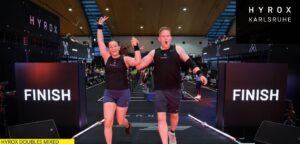
More than a race. A stronger tomorrow.
- The stopwatch gave us the result.
- The experience gave us direction.
Before the Race
When motivation ends, SISU begins.
Warm-Up
- A few Wall Ball repetitions
- Sandbag transition practice
- Approximately 300 metres of rowing
A Strong Start
- Two energy gummies before the start
- Two energy gummies around the Row station
- Water at every available Roxzone water point
- A few sips of Red Bull before the Sandbag Lunges
The Result
Race Snapshot
| Metric | Result |
|---|---|
| Overall time | 1:25:12 |
| Age group rank | 10 |
| Overall rank | 212 |
| Run total | 46:51 |
| Roxzone | 6:41 |
| Station total | 31:44 |
Age Group Comparison
| AG Rank | Pair | Overall Time | Run Total | Roxzone | Station Total |
|---|---|---|---|---|---|
| 2 | Lorch / Sautner | 1:11:35 | 38:36 | 4:13 | 28:50 |
| 3 | Philipp / Kaiser-Maireis | 1:14:09 | 40:48 | 5:54 | 27:31 |
| 4 | Daniels / Casper | 1:16:32 | 40:20 | 5:57 | 30:21 |
| 5 | Hagedorn / Wisser | 1:16:32 | 44:52 | 4:48 | 26:56 |
| 10 | Sami / Katja | 1:25:12 | 46:51 | 6:41 | 31:44 |
Sub75 Benchmark
| Category | DrivenBySISU | Target benchmark | Difference |
|---|---|---|---|
| Running | 46:51 | 40:48 | +6:03 |
| Stations | 31:44 | 27:31 | +4:13 |
| Roxzone | 6:41 | 5:54 | +0:47 |
| Overall | 1:25:12 | 1:14:09 | +11:03 |
Small steps. Bigger results.
Running: The Biggest Opportunity
| Running split | Time |
|---|---|
| Run 1 | 4:11 |
| Run 2 | 5:50 |
| Run 3 | 6:11 |
| Run 4 | 6:20 |
| Run 5 | 6:23 |
| Run 6 | 6:25 |
| Run 7 | 6:26 |
| Run 8 | 5:09 |
Data Snapshot
Sub75 benchmark: 40:48
Difference: +6:03
The biggest difference was not reaching the finish. It was maintaining running speed under fatigue.
Our Strongest Station
Strongest Station
- 23 seconds faster than AG Rank 2
- 21 seconds faster than AG Rank 3
The data confirms what we felt during the race. The Sled Push is no longer a weakness. It is one of our strengths.
Where Station Time Was Lost
| Station | DrivenBySISU | Benchmark | Difference |
|---|---|---|---|
| SkiErg | 4:20 | 4:01 | +0:19 |
| Sled Push | 1:59 | 2:20 | −0:21 |
| Sled Pull | 4:30 | 4:06 | +0:24 |
| Burpee Broad Jump | 4:18 | 3:10 | +1:08 |
| Row | 5:08 | 4:36 | +0:32 |
| Farmers Carry | 1:46 | 1:45 | +0:01 |
| Sandbag Lunges | 4:39 | 3:33 | +1:06 |
| Wall Balls | 5:04 | 4:00 | +1:04 |
- Burpee Broad Jumps
- Sandbag Lunges
- Wall Balls
Sled Pull: A Specific Development Area
- More efficient rope handling
- Better use of body position
- Stronger and more repeatable pulls
- Cleaner partner changes
- Returning to running rhythm more quickly
Efficiency first. Power where it matters.
Roxzone: Time Available Without More Fitness
Data Snapshot
Sub75 benchmark: 5:54
Difference: +0:47
- More decisive station entry and exit
- Clearer communication before each station
- Pre-planned water intake
- Less hesitation around equipment
- Faster return to running
Free speed does not always come from greater fitness. Sometimes it comes from moving smarter.
What Went Well
Controlled Pacing
Competitive Sled Push
Energy Until the Finish
Team Execution
Focus Areas
1. Running
2. Burpee Broad Jumps
3. Sandbag Lunges
4. Wall Balls
5. Sled Pull
6. Roxzone
Recovery Started at the Finish Line
- Shower
- Food
- Fluids
- Body maintenance
- Sleep
What Karlsruhe Taught Us
- Faster and more consistent running
- More efficient Burpee Broad Jumps
- Stronger Sandbag Lunges
- A better Wall Ball strategy
- Cleaner Sled Pull execution
- Faster transitions
- Smarter Roxzone movement
The Sisu Moment
Same Team. Bigger Tomorrow.
Final Thoughts
Small steps. Bigger results.
Same Team. Bigger Tomorrow.
NEXT RACE: HYROX HELSINKI / FINLAND 19.12.2026
Our second HYROX race will happen in Helsinki Finland on December 19th, 2026.